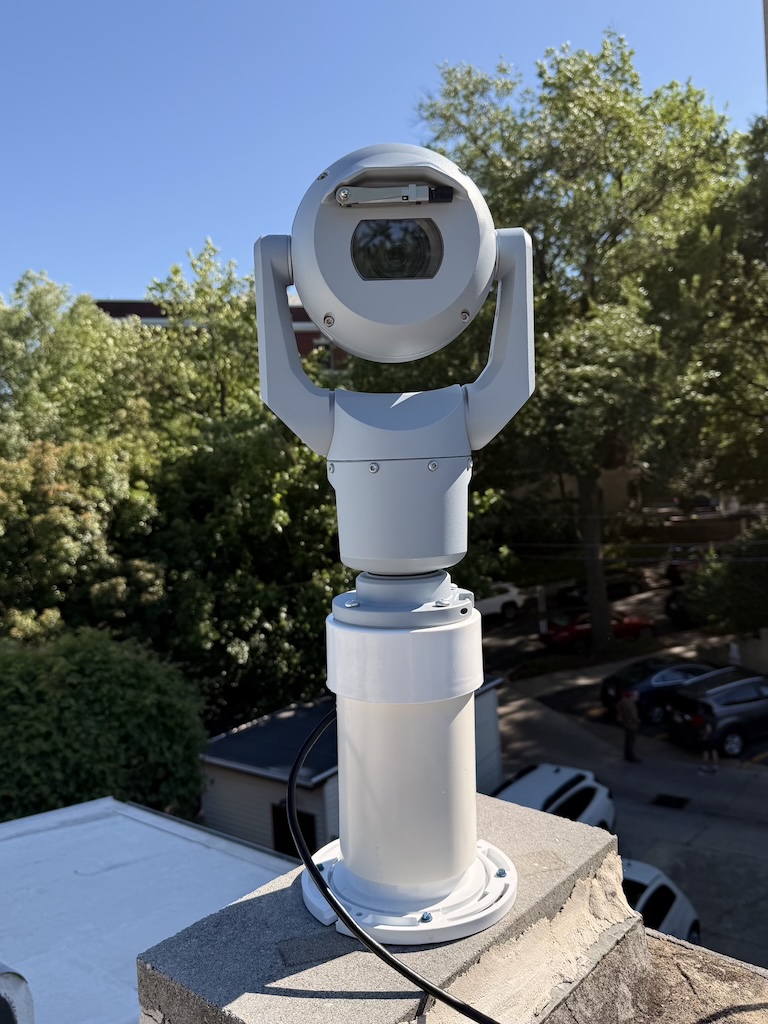
I have been running an Axis Q6215 on my roof for tracking aircraft for the past couple of years. It has been doing a heroic job, but recently lost the ability to focus. I have always had an eye on the Bosch MIC series of cameras which have a pretty cool looking design. When I saw one up pop on EBay for a good price, I decided to scoop it up as a replacement.
I had high hopes for this camera… unfortunately I was disappointed. The camera hardware is well made and looked hella-sturdy. The optics seemed good enough – there were some aberrations around the edges at max zoom. The real killer for me though was the crappy API control…
Bosch’s tilt convention isn’t quite ONVIF’s tilt convention
The first issue was that small tilt
commands moved the camera by a different amount than I expected. I wrote a
quick raw-ONVIF probe that sends AbsoluteMove(pan=0, tilt=89) and then checked the camera’s elevation, which was closer to
45° elevation. Not 89°.
A few more data points and a linear fit told the story:
| Physical elevation | ONVIF tilt the Bosch reports |
|---|---|
| -55° (mechanical limit, looking down) | -178° |
| 0° (horizon) | -43° |
| +90° (zenith) | +180° |
The Bosch takes its actual 145° mechanical tilt range and stretches it
across the full ONVIF range of ±180°. So ONVIF tilt is roughly 2.5×
physical elevation. Nothing in the ONVIF spec requires this, but nothing
forbids it either — SphericalPositionSpaceDegrees is allowed to advertise
whatever YRange the device wants.
The fix was to add a two-point linear remap to the ONVIF backend:
CAMERA_ONVIF_TILT_PHYS_MIN=-55
CAMERA_ONVIF_TILT_PHYS_MAX=90
The backend translates physical elevation ⇄ raw ONVIF tilt on every read and write. The rest of the controller can keep speaking in elevation (0° = horizon, +90° = up) and not care.
Proportional speed is real, and it’s hidden in an AUX command
After all that, tracking should have worked. It mostly did, except the camera made small lurching motions at high zoom instead of smoothly following the plane. The PID’s commanded rate was around 0.2 deg/s — the camera was doing nothing for a while, then a 0.8 deg/s pulse, then nothing again.
It turns out PTZ cameras have a feature called Proportional Speed that auto-scales pan/tilt rate based on the current zoom level. At high zoom the camera moves much slower per unit of velocity input, so you can fine- tune the framing. For a human with a joystick this is great. For a PID loop trying to track a moving target, it means the gain changes by ~30× as you zoom in.
The MIC 7000i’s web UI doesn’t have a toggle for this. The setting is
buried in a Bosch AUX command (AUX 88 ON/OFF) that you have to find by
reading Bosch’s BICOM Absolute Positioning
PDF.
Once I knew the AUX number, the web UI’s Live > Aux section will send it.
The Bosch has exactly 15 speed buckets
With proportional speed off, tracking got better but still wasn’t smooth. I instrumented the rate scaler with a probe that sends a known velocity to the camera, waits, and measures how far it moved. The result was remarkable: the camera responds at only 15 distinct rates plus stop. That’s it. Send a commanded velocity of 0.3 deg/s, 0.7 deg/s, or 1.5 deg/s and the camera does exactly the same thing — bucket 1, about 0.77 deg/s. Anything in between is quantized away.
The BICOM doc confirmed this is the camera’s actual rate encoding: a 4-bit signed speed value per axis. 16 levels (15 + stop). Same on the wire, just hidden inside ONVIF’s normalized [-1, +1] velocity space.
This means the PID control has a step-function-shaped response, which is delightful for the integrator. The integrator winds up until it pushes the commanded velocity past bucket 1’s threshold, the camera lurches, then overshoots, then the integrator winds the other way. The control-loop plots looked like a square wave.
The four proportional speed modes are also buckets
There are four proportional speed modes (Super Slow / Slow / Medium / Fast) you
cycle through via another AUX command (AUX 700). I wrote a sweep that
walks through the four modes × three zoom levels, sends raw normalized
velocities at evenly spaced points across the camera’s 0…1 input range,
and fits the linear bucket model. At the tracking zoom of 0.95, the data
came out:
| Mode | Bucket step (°/s) | Max rate (°/s) |
|---|---|---|
| Super Slow | 0.13 | 1.77 |
| Slow | 0.15 | 1.49 |
| Medium | 0.16 | 1.52 |
| Fast | 0.28 | 7.35 |
So in Super Slow mode at 95% zoom, the PID can ask for a rate as small as 0.13°/s and the camera will actually do it. Eight times finer than the previous mode. The bucket structure still has a hard floor. The PID can ask for 0.05°/s of correction, but the camera will round that up to 0.13°/s. The controller is now stable, but at the high-zoom limit the image has visible micro-jitter because every correction is at least one bucket.
At the end of the day there didn’t seem to be a way to get smooth tracking with the Bosch camera. I am going to go back to an Axis camera. The biggest selling point for me is having a higher degree of control over the continuous motion. With the Axis you specify between 0-9999, but each step is mostly linear and maps to an actual change in the rate of motion.